
We dug into the anonymized data across ClimbLife gyms – no leaderboards, no vanity totals, just the patterns that are useful if you set boulders or run a gym. This edition is all about bouldering; rope walls get their own article.
One honest caveat: this is data from climbers who log their climbs in an app – the dedicated slice of your crowd. Keep that in mind; we’ll point out where it matters.
The week has a rhythm (and Friday night is an opportunity)
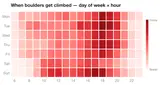
Plot logged boulder ascents by day of the week and hour of the day, and the gym’s pulse becomes visible:
What it means for operations:
- Weekdays peak at 6–7 pm. The after-work session is the heartbeat of indoor bouldering – that’s the window your desk, your café and your walls need to survive.
- Weekends run on a different clock. They fill up from late morning, peak in the early afternoon and fade by dinner. Weekend evening shifts are quiet.
- Friday and Saturday evenings are the deadest evenings of the week. Climbers have social lives too. If you’re looking for a slot for a private event, a comp after-party or maintenance – it’s right there.
- Tuesday is the busiest day overall. The week’s motivation is still fresh.
A new boulder lives fast and dies young
When do climbers actually climb a boulder – right after it’s set, or steadily over its life? The data is unambiguous:
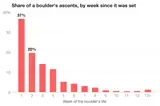
More than half of all ascents a boulder will ever get happen in its first two weeks on the wall. Week one alone takes over a third. After a month the curve flattens to a trickle – the regulars have done it, and it quietly waits for the reset. (A typical boulder in ClimbLife gyms stays up for five to six weeks; lead routes live on a completely different timescale – see the rope edition.)
This decay curve is your engagement engine – every reset restarts it. Two practical notes from the data:
- Gyms overwhelmingly reset mid-week: about 70 % of new boulders appear Wednesday to Friday, fresh for the weekend.
- Meanwhile the biggest logging crowd of the week shows up Tuesday evening – right at the end of the novelty drought. Food for thought when planning your reset schedule.
What gets set vs what gets climbed
Route setters plan a spread across grades. Climbers then vote with their hands. Here’s how the two compare across ClimbLife gyms:
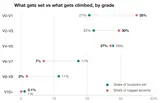
The pattern is clear: boulders up to V3 are about 42 % of what gets set but 64 % of what gets climbed. At the other end, V6 and harder make up nearly a third of the setting work and single-digit percent of the logged traffic – a V0–V1 boulder collects on average about ten times more ascents than a V8+.
And remember the caveat from the top: these are loggers, the dedicated climbers. Your actual crowd includes birthday parties and first-timers, so real-world demand skews even further toward the easy end.
This is not an argument to stop setting hard – your strongest members are often your most loyal, and aspirational boulders are part of what a gym is. But it puts a number on something setters know by feel: the easy end of your gym does most of the work, so it deserves the same setting love as the king line.
The harder you set, the more they’ll argue with your grade
When climbers log an ascent in ClimbLife they can suggest a grade. Most of the time they agree with the setter – but the agreement falls apart as the grades go up:
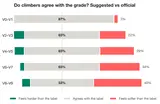
On V0–V1, 87 % of grade suggestions match the official grade. By V8–V9 it’s barely half – and the disagreement is strikingly one-sided: climbers almost always vote the boulder softer, not harder. (Partly human nature – “that V8 was soft” is a better story than “that V8 shut me down” – and partly the fact that whoever suggests a grade on a V8 usually climbs V8.)
Two useful things follow for setters:
- Expect pushback on your hard grades; it’s structural, not personal.
- Watch the direction of suggestions on your walls. A boulder where everyone votes softer is a data point, not an insult – and a wall where they consistently vote harder might be quietly demoralizing your intermediates.
One more encouraging pattern from the same feedback data: star ratings rise with difficulty – from ★4.2 average on V0–V1 to ★4.6 around V8. Setters clearly pour their craft into the hard stuff. The flip side: the easy boulders, where every beginner forms their first impression of your gym, are the lowest-rated part of the wall.
The weekly habit – and all that unfinished business
A few smaller numbers that describe the regulars your gym runs on:
- The median gap between two logged bouldering sessions is 7 days. Bouldering is a weekly ritual, wedged into the same calendar slot – one more reason same-weekday reset schedules work so well.
- A median bouldering session covers 7 boulders and about 13 individual goes; the top 10 % of sessions tick 21 boulders or more. (Worth knowing: climbers overwhelmingly log what they send – failed boulders make it into the log far less often, so the real number of tries is higher.)
- A quarter of bouldering sessions end with an unfinished project logged. And here’s the brutal part: only about 1 in 10 of those projects ever gets finished on a later visit – usually the reset gets there first.
That last number is worth sitting with. Unfinished projects are a reason to come back – but only if climbers know how much time they have left. It’s exactly why ClimbLife tells climbers which boulders are about to be stripped: closure, it turns out, needs a deadline.
Where this data comes from
These patterns come from anonymized, aggregated climb logs across gyms running on ClimbLife. Every partner gym sees the same insights for its own walls – which grades are over- or under-served, when the gym actually fills up, how long its boulders really live, and what climbers think of the setting.
Got rope walls too? Read the companion piece: 6 data insights for rope climbing gyms.
Let’s have a chat about what your gym needs — whether over the phone or in person