
We dug into the anonymized data across ClimbLife gyms – no leaderboards, no vanity totals, just the patterns that are useful if you set routes or run a gym. This edition is all about rope climbing; bouldering got its own article.
One honest caveat: this is data from climbers who log their climbs in an app – the dedicated slice of your crowd. Keep that in mind; we’ll point out where it matters.
The week has a rhythm
Plot logged rope ascents by day of the week and hour of the day, and the rope walls’ pulse becomes visible:

What it means for operations:
- Weekday evenings peak at 6–8 pm – and rope evenings stretch later than boulder evenings. A roped session with a partner is a bigger commitment, and people give it time.
- Sunday is a rope day. It fills up from late morning and stays busy through the afternoon – the classic long weekend session.
- Friday and Saturday evenings are the deadest slots of the week. If you’re looking for a time for a private event or maintenance, it’s right there.
- Tuesday is the busiest day overall, just like on the boulder side. The week’s motivation is still fresh.
Mornings belong to the autobelay
Autobelays account for roughly a quarter of all rope climbs logged in ClimbLife. But that share is anything but constant across the day:
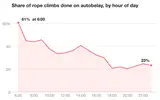
At 6 in the morning, about 60 % of rope climbing happens on autobelay. By the evening peak it drops to around 20 %. The reason is obvious once you see it: nobody has a belay partner at 6 am. The autobelay is the solo climber’s best friend – before work, at lunch, whenever the rest of the gym is still asleep. In the evening, partners are everywhere and the rope takes over.
The takeaway: autobelays don’t just serve beginners. They unlock the hours when your rope walls would otherwise stand empty – and they’re what makes a morning visit possible for a whole segment of your members.
A route lives slow – but its first month decides a lot
A typical lead route in ClimbLife gyms stays on the wall for well over a year – boulders, by contrast, are stripped after five to six weeks. But look at when a route’s ascents actually happen:
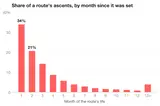
Even with routes, novelty rules: a third of all ascents come in the first month, and more than half within two months – the first month of a route looks just like the first week of a boulder, stretched out. The difference is the tail: a route keeps collecting ascents for a year or more.
For route planning this means two things at once: you don’t need boulder-style reset cadence on rope walls – but a steady trickle of fresh routes keeps the novelty engine running far better than one big annual re-set. Stagger it wall by wall and there’s always something new to try.
Where projecting begins
Rope climbers log whether a route went down first go, after working it, or not yet at all. Stack that by grade and you can see the exact point where climbing stops being about mileage and starts being about projecting:
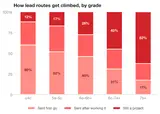
On routes up to 5c, more than half of all logged climbs are first-go sends and only about one in eight is an open project. From 6c up, projects take over – at 7b+, nearly two thirds of logged climbs are project burns, not sends.
This pairs neatly with the lifespan data above: easy routes are mileage and can rotate faster; hard routes are relationships – a 7b that stays up for a year is not stale, it’s somebody’s season goal. Strip it two weeks after they started working it and you’ve taken away the reason they kept coming.
Route grades don’t get argued with (much)
When climbers log an ascent they can suggest a grade. On boulders, agreement with the official grade collapses as difficulty rises – on V8–V9, 40 % of suggestions say “softer”. Rope routes tell a much calmer story:
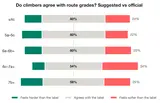
Agreement sits around 60 % across the whole scale, and the disagreement is split in both directions instead of piling up on “softer”. Sport-climbing grades have a century of consensus behind them, and it shows – route setters inherit a much more stable yardstick than boulder setters do.
The one place climbers push back hardest is 6c–7a+, where “feels softer” peaks at 34 % – exactly the range where projecting begins and egos meet season goals. If you’re going to double-check any grades on your walls, start there.
Rope and boulder are different sports – even inside one gym
Gyms that offer both disciplines often treat their climbers as one crowd. The logs say otherwise:
- At gyms with both rope walls and boulders, only about a third of climbers log both disciplines. Some 44 % stick to rope, 21 % to boulder.
- Even the climbers who do both almost never mix them in one visit – only 11 % of their sessions contain both a rope climb and a boulder. It’s rope day or boulder day, rarely both.
- The rhythm is the same, though: a median of 6 days between rope sessions, 7 between boulder sessions – a weekly ritual either way. A median rope session is 5 routes; a median boulder session, 7 tops.
For operators this cuts two ways. There’s an untapped audience inside your own walls – two thirds of your rope climbers haven’t made bouldering a habit, and vice versa. And since disciplines live on separate days, cross-selling them doesn’t cannibalize visits; it adds them.
Where this data comes from
These patterns come from anonymized, aggregated climb logs across gyms running on ClimbLife. Every partner gym sees the same insights for its own walls – which grades are over- or under-served, when the gym actually fills up, how long its routes really live, and what climbers think of the setting.
Got boulders too? Read the companion piece: 5 data insights for bouldering gyms.
Let’s have a chat about what your gym needs — whether over the phone or in person